Monday, 3 May 2021

Back to tidal waters


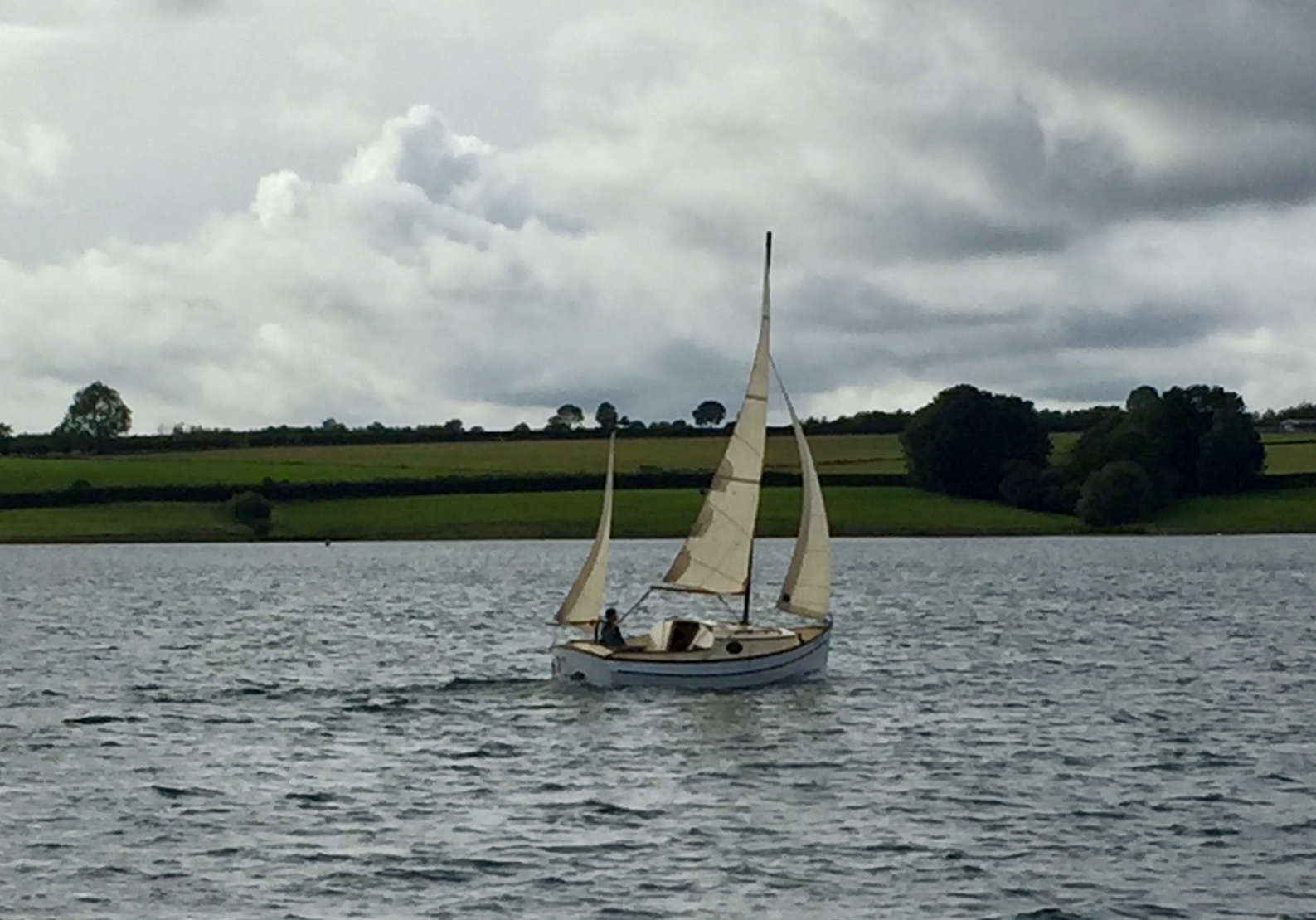
Daisy III pictured off Pin Mill on the River Orwell

Following last weekend's Broads trip, the forecast for the early part of the Bank Holiday weekend promised light winds, mainly from the east - sufficiently benign for a trip within the shelter of Harwich estuary.

Launching at Woolverstone, I sailed round to Erwarton on the Stour for the evening.

Water ballast tanks filling at Woolverstone

Slow progress against the ebb, up the Stour - Erwarton ahead

The next morning, gentle NW winds persisted.  I sailed out of Harwich Harbour, made a loop around the Pye End navigation buoy, and then had a pleasant beat back into the harbour and up the Orwell, ready for retrieving onto the trailer with the mid-afternoon tide.
A bright morning on the Stour

Pye End Buoy

Presumably a sister ship to the one which was recently wedged in the Suez Canal


Off Pin Mill, a Drascombing friend who owns a coaster spotted me, and took these great snaps!  It is so good to see pictures of Daisy III in sailing action.

Back on the trailer - this time skewed on the port side - more on this in another post...

25.9nm.  Red track - Saturday 1st May.  Yellow track, Sunday 2nd May


Sunday, 25 April 2021

Shakedown sail


Saturday evening mooring on the River Waveney

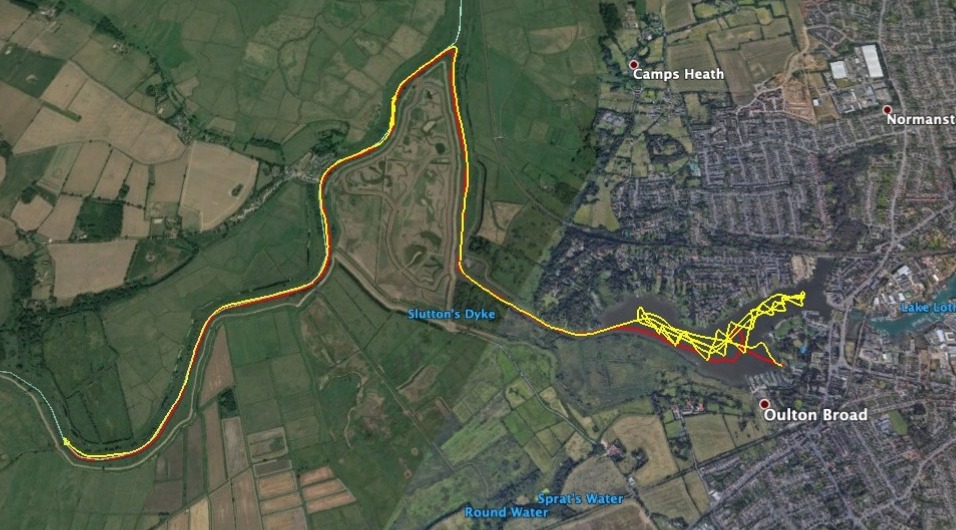
For a first sail, given a predominance of easterly winds recently, the decision was made to make the season's shakedown sail a Broads affair.  Launching at the public slip into Oulton Broad, some time was spent filling in the Broad with the GPS, before sauntering along the Waveney to find a suitably quiet, countryside mooring - just me, the boat and the natural beauty of this location.
Sailing along the Waveney


Extensive modifications to the trailer were put to the test.  Launching went well enough, but recovery onto the trailer needs some more work since the changes have exacerbated a previous tendency towards skewed recovery.  The large mudguard on the starboard side is now sitting within a centimetre of the hull, which doesn't leave much room for lateral movement on the road.  However, the boat has survived the trip.  More of this in another post...

10.7nm

Sunday, 22 November 2020

Mast crutch and winter wrapping

 After several weeks of wet weekends, there was finally a reasonably dry weekend which gave an opportunity to put the winter covers on Daisy III.  It's always important not to winterise the boat whilst it is still wet - the prospect of the damp turning to some sort of rot is not enticing!

The first job has been to create a forward mast crutch, making use of the Samson Post.


This solution will enable the storage of the mast much further forward than previously, particularly beneficial in avoiding such a big overhang to the rear.  Since the trailer modifications have increased the length between the winch post and the hitch, there is now greater scope for the effectiveness of this modification.

The solution will do for the winter, but in the spring judicious use of leather should avoid chafe from the slight lateral play in this arrangement, both between samson post and crutch, and between crutch and mast.

Daisy III is now under its winter cover.  The other advantage of the above modification is that there can be free flow of air under the cover fore and aft which, again, should help avoid a build up of dampness.


Saturday, 14 November 2020

Water ballast inspection hatch opening tool


The BC20, in common I think with the BC23, has forward and aft water ballast chambers, connected by a piece of tubing which runs along the bilge next to the centre plate.  Day to day access is to the rear chamber via an easily-opened hatch in the cockpit floor.  The forward chamber is actually in two halves, port and starboard, each serviced by a much less easily-opened inspection hatch below a small storage area just below the V-berth.

Mostly, one would leave these as they are, the chief concern during the season being to ensure they are sufficiently watertight to prevent ingress of water to the cabin from the water ballast.  However, during the winter, it's rather concerning to think of this chamber remaining damp and enclosed so I rather prefer to open up the hatches, dry out any remaining water and leave the covers off to allow air to circulate.  However, despite applying ample Vaseline around the covers when closing, they become incredibly difficult to remove - particularly painful on the fingers which have little purchase on the two indented areas.  So, following a quick search on YouTube, I happened upon a short video of an easily made tool.  This has now been crafted using a couple of bolts, some electrical masking tape and an old piece of driftwood I picked up years ago and decided to keep thinking it might come in useful one day!

The great thing is that the tool works an absolute treat, and both hatches opened with relative ease.


Trailer modifications and other end of season work

Daisy III now sitting on its modified trailer - new axle with braked wheels.  The widest point of the hull is quite close to the new mudguards, but this should hopefully not present a problem.

It has been a strange summer in an even stranger year.  Following the last cruise in August, it became apparent that there were serious issues with the boat trailer, principally due to the overall towing load being too heavy for the un-braked trailer.  

The original BC20 was sold as being 451kg when 'empty', sitting on an un-braked trailer of 200kg, thus allowing just under 100kg for additional loads prior to reaching the towing limit of 750kg for such a trailer.  This seemed a flawed approach for all sorts of reasons:

  • Despite polite enquiries, it was not possible to achieve a straight answer to the important question of what precisely constituted an 'empty' boat.  Does it mean the finished hull alone, or does it include mast, spars, sails, cabin bunk cushions, rigging?  These items would easily make up the 100kg difference.  Moreover, this particular boat is a modified version, currently with a Lavac sea loo installed on the starboard side.  How much additional weight is this?
  • Anyone who owns a boat will appreciate the necessity of carrying all sorts of additional kit and clobber.  Must this be carried separately, loaded onto the boat before each launch, and correspondingly removed at the end of a sail?  For one, an outboard motor adds a considerable weight and is the sort of item so awkward to load that the single handed sailor would be excused for wanting to fit it just once, at the start of the boating year, and then leave in place throughout the season.  Then, one must consider anchor, chain, second anchor, ropes, paddle, boat hook, electronics, safety gear, fenders, tools, charts.  And that's before the day-to-day essentials such as cooking/eating essentials, ingredients, water, clothing, boots, wet weather clothing etc.
  • This is a cabined boat which is all the more reason why one would want to fit out the cabin with all sorts of additional equipment.
  • Even if it were possible to keep the weight of the boat below the 750kg limit, it is an undeniable fact that the overall weight will at least be pushing up against that limit.  Travelling, safe in the knowledge that the towing weight was well below any such limits, is much the preferable option.
Having done some summer arithmetic (illustrated below), using A-level mechanics 'moments of forces' calculations alongside the somewhat crude use of a set of bathroom scales, the conclusion was that, even with most kit removed, but spars, sails, cabin cushions, ropes and fenders included, the weight of the boat and trailer was at least right on the towing limit and, quite possibly well over.  Summer anecdotes from other boat owners being pulled over by the police, and then directed to the nearest weighbridge were a considerable cause for concern.  Then, it was the case that much of August was unseasonably windy (conditions this skipper doesn't particularly enjoy) with the brief windows of more settled weather coinciding with other commitments.  

This is somewhat crude, and subject to a considerable margin for error, not least since it wasn't easy to roll the boat back on its trailer without fear of the whole thing tipping up.  But the principle is that the downward force exerted by the jockey wheel is measured twice, once with the boat in its usual position, and then again with the boat rolled backwards, whereby the centre of mass of the boat also goes backwards by the same amount.  The outcome of this mini-experiment is that the boat and trailer weighed in at 900kg!!  However, let's assume, for example, that there had been an ever so slight misreading of measurements, and that the boat went backwards by 7cm as opposed to 6.5cm - this would have knocked something like 66kg off the mass of the boat. 
So, to repeat, crude measurements, and subject to a large margin of error...

Hence, it seemed to be the right time to take drastic action, in the form of having the trailer modified to incorporate brakes.  Amongst other things, this involves a new axle with larger wheels, raising the height of the trailer frame (see further modification below).  There is nothing innovative about this action; a number of other BC20 owners have previously done the same, either swapping their trailer for a braked version, or having the existing trailer modified to a braked version.  In so doing, the upper towing limit becomes much more dependent on the type of vehicle rather than the trailer.  Currently, this is a Skoda Superb estate 4x4, with a braked towing limit of two tonnes and, whilst there is no intention of pushing anywhere near this limit, the boat can now be loaded with the kit needed and this can remain aboard throughout the season.
New hitch and jockey wheel


CLH trailers, who built the original and who had already carried out similar conversions, were engaged to do the work.  This was not without its difficulties due to the various covid lockdowns, and delays in them taking delivery of the requisite parts.  To cut a long story short, a hastily arranged swap of the completed trailer at the Welsh border the day before the second lockdown commenced in England has ensured Daisy III is now back at home and awaiting a period of relatively dry conditions prior to putting on the winter covers.

Whilst doing this work, it was timely to carry out a few other modifications.  For one, the raised height of the trailer will cause further bother in trying to winch the boat over the rear swinging cradle on launch and recovery, so a couple of rollers have been installed at the lowest central part of this.  This is yet to be tested, and it will at least be spring in 2021 before this happens.  Hopefully, the process will be similar to this launch and recovery video from Swallowyachts.  


View from the rear, also showing the first of two new, wider central keel rollers

It remains to be seen as to how the bow, with winch strap, will roll over these.  Fingers crossed for Spring 2021...

Two of the keel rollers further forward have also been replaced with wider rollers which hopefully are better suited to the relatively wide keelband for this boat.


Tuesday, 4 August 2020

Early August cruise


This short cruise was characterised by awkward weather - the breeze never really settled.  Every cloud made its introduction with a smack around the face, and gracefully departed with a lash in its tail.  Winds were never completely overpowering, but one could never really relax, always having to second-guess where the next gust was coming from.

Saturday, August 1st - launch at Titchmarsh Marina, sail to the River Stour

The slipway at Titchmarsh Marina

Trialling a new place for the ensign

I sailed from the Walton Backwaters to Harwich, and anchored opposite the container ship terminals, mainly to sort out things on the boat.  The ensign, previously installed on a now snapped post poking out from the stern transom, has found a new home at the top of the mizzen.  It works well enough except that it gets twisted around its staff when the mizzen is furled/unfurled.  I can just about reach it with a pole but I can't see this being a permanent solution.  I'm beginning to see more sense in the stern frame used on BC20 No1.

Drascombe coaster Dewineaeth, shaking out a reef in Harwich Harbour

Later in the day, I enjoyed a beat up the Stour, particularly catching up and overtaking a Cornish Shrimper on a similar course.  Daisy III isn't necessarily quick, but she points well.

Of an evening, a still disorganised cabin, but some welcome victualling.

I like to cook out in the cockpit.


17.3nm

Tuesday 2nd August - Stour, a bit of Orwell and then Hamford Water

There wasn't really a plan for this cruise, just seeking opportunities to sail in familiar waters, becoming better used to the new boat and its various sail combinations.
Today, having dragged anchor overnight in conditions which refused to settle, I set off with double reefed main - which, as a single sail combination oddly seems to work better than with a single reef.  I soon added the jib, and subsequently the mizzen.


Peaceful anchorage in Hamford Water

22nm

Monday 3rd August
Again, with no particular plan, I set off for Harwich Harbour and decided to sail up and down the Stour again for no reason other than to continue stretching the sea legs of this boat.  The whole day was spent in motion and under sail - various combinations of sail.  When I needed to add or remove a reef/sail, to make coffee/lunch, I simply hove to and the boat does this just as well as Daisy II did.  The outboard wasn't troubled once.


As the day proceeded, clouds gathered and I was caught in some inevitable bad weather.
Storm clouds over Harwich

I did a bit of to-ing and fro-ing around the Holbrook Bay area, waiting for various storms to pass, before heading back down towards Harwich, aiming for an anchorage just off Pin Mill.  Inevitably, another storm lashed me on entering the Orwell.
Storm clouds over Shotley


Peace returned for the evening - a lovely anchorage in the lee of the woods just east of Pin Mill.

30.4nm

Tuesday 4th August - return to Titchmarsh, recovery and home
The other bit of wildlife witnessed today was a seal which had climbed aboard a tender, attached to its mother ship.  I imagine the skipper and crew had an interesting time trying to remove the seal from its perch.  In the meantime, this post is often frequented by cormorants drying their plumage.

Initially there as no wind today, but as I reached Harwich Harbour, an increasing SE breeze set in.  I had a pleasant beat across Harwich Harbour against the flood, but conditions out in Dovercourt Bay were too choppy given my need to be back at Titchmarsh by noon.  So, I furled sails and motored back to the slipway.
12.6nm

Overall, a really pleasant cruise
82.3nm